Physics Inside-Out
A Paradigm of Peace
© 2019
by Loren Booda
|
|
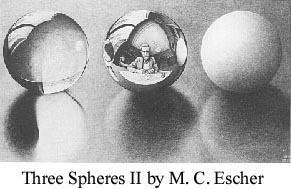
Our world reflects upon a sphere Revealing silvered twin From whose versed image shall appear The universe within. |
| Phase Reality! |
| Quantum mechanics inverts phase space through Planck's constant, as relativity inverts spacetime through the Planck length, revealing cosmological symmetries |
The essential challenge before us is to conceive a responsible and peaceful paradigm of physics, testable yet not malicious. If even half of my assertions on this website adds original knowledge to physics, I would be satisfied that I made a contribution to the field. T-duality, a basic symmetry of superstrings, relates a dynamic variable and its reciprocal through a Generalized Uncertainty Principle. (An informal introduction to superstrings, and T-duality in particular, may be found at the Wikipedia article String Duality). The two "Inside-Out" (I-O) essays following assert basic physics utilizing a T-duality analog, "phase-duality," that modifies first the Schrödinger wavefunction and secondly general relativity's metric tensor. P-duality juxtaposes these non-Newtonian theories and correlates nonlocal events with those local. I-O phase space can appear as concentric, "singular," limitless and invertable spheres, associating immediate with indirect interference. P-duality simply recognizes phase in physics as having an analogous, reciprocal component. String theory, which innovated T-duality, substitutes for "standard" quantum gravity parameters a wave compactification among intraspatial dimensions (that is, a Calabi-Yau manifold). Under both T- and P-duality, the geometry and dimensionality of the macrocosm complement those of the microcosm. E.g., the Calabi-Yau manifold, when inverted through a Planck n-sphere of radius L*, describes a polytope in spacetime. Additional dimensions link events in dynamical space to those in a similar but transposed space. P-duality doubles the dimensions available to the accustomed quantum wavefunction by establishing an I-O symmetry between conventional phase space and its inverse. (Bell's interconnectedness theorem concludes: "No physical theory of local hidden variables can ever reproduce all of the predictions of quantum mechanics." See Nick Herbert's Quantum Reality, especially Chapter 12.) Thus, unveiled I-O phase space interference determines at least twice the information potentially observed as would conventional phase space alone. The I-O complementarity enables many quantum interpretations -- like basic perspectives on quantum field theory and its virtual particles -- and explores semiclassical aspects of modern physics. P-duality modifies Einstein's spacetime metric tensor by means of a quantized "action-equivalent radius of curvature" and compactifies spacetime by reciprocity through the local Planck radius. Faster-than-light (non-local) actions S ', of quantum mechanics, can be modeled simply with local actions S turned "I-O" across the singular surface of radius h, the value of Planck's constant. That is, h2=SS '. Antigravitational (dark energy) spacetime intervals Δs', of general relativity, can be modeled simply with local spacetime intervals Δs turned "I-O" across the singular surface of radius L*, the value of the Planck length. That is, (L*)2=Δs(Δs'). |
Predictions interfere with outcomes - L. B.
|
My next two essays on duality were inspired by Edward Witten, especially from his article "Reflections on the Fate of Spacetime," which appeared in Physics Today, April 1996. See also his article "What every Physicist should know about String Theory," from Physics Today, November 2015. P-Duality: Quantum Mechanics Inside-Out | |
| by Loren Booda | |
| Interchanging variable action and Planck's constant in a real quantum wavefunction obtains a spectrum of virtual states that invert standard eigennumber solutions |
Inverted dimensions occur foremost in physical theory as part of the crystallographic reciprocal lattice. Another such transformation (deriving from Euclid) regards countless parallel lines on a plane which seem to approach one vanishing point at the horizon. When this observer nears the vanishing point, a circle of isotropic rays of sight (originally bivalent to her) would now appear to be a univalent semicircle of continuous parallel rays as seen from her origin in the foreground. Inverse phase space contains all virtual states described by "virtual wavefunctions," φ-. Such wavefunctions differ from their conventional counterparts, φ, by the interchange of their variable actions S with h (Planck's constant). I. e., φ[S, h] ↔ φ-[h, S]. (Square brackets indicate a function in general unless otherwise noted.) "Conventional" (real) phase space transforms to "inverse" (virtual) phase space, and vice versa, upon such a dynamic inversion through h. A virtual wavefunction generates action eigennumber solutions reciprocal and symmetric to those of its conventional counterpart. Together they obey both the de Broglie and Einstein postulates, and can be expressed in a linear Schrödinger equation. The mathematical justifications for a quantum wavefunction are essentially identical for both conventional and inverse. The dual wavefunctions evolve particles from their mutual interference, increasing geometrically the productivity of either wavefunction alone. The mirror symmetry of P-duality is defined: virtual quantum states are represented in reciprocal phase space through an inverse wavefunction argument as real quantum states are represented in traditional phase space through a conventional wavefunction argument. The inverse time independent free-particle wavefunction, φ-[r']=B'·exp(-2πi(h/r'p')), generates action eigennumbers reciprocal to those of the conventional time independent free-particle wavefunction,
φ[r]=B·exp(-2πi(rp/h)), and represents virtual, rather than real states. Action eigenvalues for the conventional wavefunction are SN[φ[r]]=rNpN=hN/2, derived through Im[φ[r]]=0, a condition of arbitrary phase. Likewise, action eigenvalues for the inverse wavefunction are SN-[φ-[r']]=(r'N-)p'N-=2h/N-. N and N- are nonzero integers. Action eigennumbers, nN and nN-, are simply action eigenvalues divided by h; thus, nN=N/2, and nN-=2/N-. Because of the nN ↔ nN- reciprocal symmetry, exclusively finite action entails there be no classically singular, zero-valued spin. Action eigenvalues of magnitude less than h/2 are defined as virtual, those between or including h/2 and 2h as mixed, and those greater than 2h as real. Both wavefunctions φ[r] and φ-[r'] share exclusively the action eigenvalues satisfying N/2=2/N-; that is, corresponding to spins 1/2, 1 and 2 -- those of most familiar particles: fermions, photons, and gravitons, respectively. Photons, having spin one, manifest as maximally symmetric (i. e., of shared eigenvalue ground state; their own antiparticle). So the principle of least action localizes particles near S =h, downward from real, and upward from virtual actions, into the arena of mixed (shared) states. A primordial singularity had initially transformed into a bivalent state, whence real and virtual phase spaces maintain initially local entanglements. They generate the family of subatomic particles from their own interference, φ[r]·φ-[r']=B·B'·exp(-2πi(rp/h+h/r'p'))=B·B'·exp(-2πi(nN+1/nN-)), with action solutions based on the Fibonacci series. In this regard, nN and nN- compare respectively to momentum modes and to winding numbers of T-duality. These actions represent solutions to the measurement problem.The one-dimensional time dependent virtual Schrödinger equation, (-(2πh)2/2m)(∂2[1/x']/(∂[φ-[1/x',1/t']]2)) + V[1/x',1/t'](1/φ-[1/x',1/t']) =i2πh(∂[1/t']/(∂φ-[1/x',1/t'])) describes the mechanics of reciprocal phase space through its corresponding time dependent virtual wavefunction solution φ-[1/x',1/t']=A'·exp(2πih(1/x'(px')'+1/E't')) with its inverted units. For a free particle in one dimension: conventional-real ↔ inverse-virtual Wavefunctions (φ): φ=C·exp(2πixpx/h) ↔ φ'=C'·exp(2πih/x'(px')') Operators (*): (px)*=(-ih/2π)(∂/∂x) ↔ (1/(px')')*=(-i/2πh)(∂/∂[1/x']) (x*)δ(x-`x)=(`x)δ(x-`x) ↔ ((1/x')*)δ(1/x'-1/`x')=(1/`x')δ(1/x'-1/`x') where δ represents the Kronecker delta function Commutators: [x*, p*]=ih/2π ↔ [(1/x')*, (1/(px')')*]=i/2πh Hamiltonians: H*=((px)*)2/2m=-((h/2π)2/2m)∂2/∂x2 ↔ (1/H')*=(1/((px')')*)22m=-((2πh)-22m)∂2/∂[1/x']2 Spectra: E=nhν ↔ E'=hν'/n' Photons passing "singly" through a double-slit apparatus develop an interference pattern at its screen similar to that projected there by "simultaneous" pairs of photons. The projected wave pattern is essentially the same whether one photon at a time interacts with the slits, or an astronomical number are rapidly affected. An inverse wavefunction interferes with a conventional wavefunction to realize their information as a wave-packet. Entangled from a common cosmological original event, these mutually nested phase spaces together embody observed objects "self-interfering" coherently where N/2=2/N-. In other words, quanta mediate an inverse/conventional wavefunction interference, comparable to that accustomed of two conventional wavefunctions. For instance, a radioactive atom's decay is determined through interference associating its underlying inverted eigenstates with their correlates, the real phase space states with which we are familiar. Everwhere a photon goes, it brings the potential for self-interference through its nested wavefunction. In effect, the photon relates altogether the reality of the observer, observational setup and object. An EPR experiment, starting with a singlet "zero" spin state, needs to consider first the possible vacuum field effects in that neighborhood. These primarily determine, before decay, the half-life of the parent particle through the real/virtual phase space interference unique to it. This experiment progresses much like the double-slit situation. The paired photons emitted sustain quantum entanglement, a statistical correlation inherent to the intersecting phase histories of each, and violate the Bell inequality. Entanglement thus entails virtual wavefunctions interfering with actual ones: reciprocally nested phase spaces maintain probabilistic causality without necessitating superluminal signaling, "hidden" variables, or myriad obsolete universes. Any zero spin field quantization would seem to violate the finitude of corresponding inverse phase space actions. Classically speaking, spin zero is not allowed in P-duality, but through quantum uncertainty, spontaneous particles can "bootstrap" potentially null regions to overcome that constraint. Thus, conventional phase space could sustain its nonzero spin continuity through complementarity, with particle pairs produced from the vacuum. Or secondly, consider a six-dimensional conventional phase space manifold embedded continuously with spin vectors. It would require a relatively singular four-dimensional zero-spin space, whose volume might define a spacetime horizon. Even thirdly, six compactified dimensions coupled reciprocally at a Planck sphere to six outer dimensions could satisfy, within six apparent dimensions, the criteria for phase space's seeming nonzero spin. The Schrödinger cat thought experiment employs an enclosure surrounding a radioactive source, a Geiger counter, a vial of poison and a cat. The setup has the potential to measure the decay of the source, break the vial and thus kill the cat. To an observer outside, the cat would exist as a quantum superposition of dead cat/live cat -- whereupon the box is opened, revealing the near absolute mortality or vitality of the feline. This Copenhagen interpretation posits a wavefunction collapse when this box is opened, causing an immediate mathematical projection between complex states of the cavity and the wall lattice -- realizing one mouser's macroscopic result. More materially, Bragg diffraction through the container demonstrates that the cat is never completely enclosed, thus allowing radiation (e.g. radioactive decay, signaling, thermal radiation or brain waves) from within the closed box to be observed on its outside. Through the entire spectrum, any enclosure exhibiting Bragg diffraction could reveal its interior states. The radiation, having escaped the container, had interfered incompletely with the quantum nature of those walls, determining that inner photonic state(s) manifest outwardly either a live or a dead cat (to an astronomical certainty). Picture an ellipsoid in phase space given by (rM*c)2+(pL*)2=h2 where M* and L* are mass and length Planck units, r is radial displacement, p is its corresponding momentum, c the speed of light and h, Planck's constant. Let that ellipsoid represent a photonic harmonic oscillator mediating real/mixed phase space (rM*c)2+(pL*)2≥(h/2)2 without, and virtual/mixed phase space (r'M*c)2+(p'L*)2≤(2h)2 within. Both quantum locality and uncertainty are depicted by the ellipsoidal Planck scale physics. This pairing of the inner, inverted phase space with the outer, conventional phase space recovers locally all values: r≥L*/2 ↔ r'≤ 2L* and p≥M*c/2 ↔ p'≤ 2M*c. Their symmetry enables quantum measurement to include microscopically the entire range of macroscopic phase space. Wavefunction reciprocal actions may provide gravitational, electric or magnetic "singularities" continuity, since they can transform a real, acute Dirac delta function into a virtual, smooth function. Upon inversion, Heisenberg's uncertainty principle reverses its inequality (with action eigenvalue lower limit N=1 now the upper limit N-=1) from ΔrΔp≥h/2 to Δr'Δp'≤ 2h. Conventionally, a singular interval, where Δr→ 0, complements a momentum uncertainty Δp→∞. Inverse phase space allows the same. This enables local virtual momentum N- states to represent quasi-continuously unbounded self-energy. Summing every momentum state of inverse phase space gives a practically infinite internal energy of compactification within the ellipsiod of uncertainty. The real phase space of a double-slit experiment maps through the ellipsoid of uncertainty, revealing a "photon's eye view" which transposes actions such as those at the slits, screen or light source. The photon's ellipsoidal perspective interrelates the subluminal aspects of that experimental phase space with the superluminal virtual states, in effect turning the universe inside-out. Now the Casimir experiment incorporates cancellation or reinforcement of virtual probability waves with the environment (lab walls, particles in space, observer, Earth etc.) outside its plates. Similarly, the virtual wavefunction of an infinite well potential has energy states with values reciprocal to those of the conventional infinite well wavefunction. Solutions of virtual wavefunctions with their inverted geometry thus juxtapose standard quantum field theory calculations. Wavefunction "collapse" now manifests Born probabilities in an accessible, physical transformation, having lost its discontinuous, nonmaterial character to the inverse wavefunction φ-[r], a local information equivalent to φ[r]. Does physics eventually underlie probability, or probability physics? Correlated from the original Planck vacuum, mutually reciprocal phase spaces enable seemingly simultaneous action-at-a-distance in spacetime. A system like Wheeler's "galactic interferometer" translates as locally compactified within a virtual ellipsoidal phase space proximal to the observer, describing why its observed interference effects appear instantaneous. The act of measurement interchanges quantum observer with object. The action of such an exchange mediates symmetry between the particles' creation and annihilation. The observer represents coherent quanta with the potential of being entangled with the object. P-duality, sharing mathematical properties initially attributed to strings by T-duality, derives phase-dependent action through traditional and reciprocal wavefunction symmetries. It also guides our accustomed philosophy of modern physics towards a new realism. Before we enact the hypothetical, albeit beautiful dimensionality of string or M-theory, compactification by inversion through action h can obtain a dual universe of accessible phase space states. Not only do many principles of quantum mechanics fit this "inside-out" paradigm in accord with P-duality, further study reveals parallels to possible spacetime reciprocity (see the next article). Quantum interpretation oversees two complementary, aboriginally entangled and inversely nested phase spaces. Interpreting the philosophy of observer as participant indicates the quantum realm as dualistic yet unified. We arc from present center to ultimate horizon - L. B. |
| P-Duality: General Relativity Inside-Out | |
| by Loren Booda | |
| This approach to general relativity calculates a first order "action-equivalent radius of curvature," whose quantum correction (1.8 x 1028 cm for a supermassive black hole) is near the Hubble radius |
The "semiclassical metric tensor," gμν[r±Δr], generates intervals of quantum spacetime divergent from the Δs of conventional general relativity. This modified tensor includes a first-order correction, an action-equivalent radius of curvature Δr=gμν[r] Δxμ (nN)-1/2RH/L*, where nN are real action eigennumbers, i. e. relative uncertainties, and Δr is the action-equivalent radius of curvature (see the previous "P-Duality: Quantum Mechanics Inside-Out"). L*, the Planck length -- typical of Planck scale physics -- and the Hubble radius RH approximate the extrema of measurable spacetime curvature. RH/L*=(nmax)1/2 represents the characteristic quantum number for spacetime. The absolute range of action eigennumbers is nmax -- on the order of the dimensionless cosmological constant, Λ. A real action S[r]=nNh≥h/2 implies a radial vector correction of conventional spacetime, and a virtual action S[r']=(nN-)h≤ 2h implies a radial vector correction of inverse spacetime; intermediate shared actions denote mixed states, of which S[r]=S[r']=h represents a shared event horizon. The inertial correction for a supermassive black hole's parameters, |Δr|=1.8 x 1028cm, is approximately the Hubble radius, as |Δxμ|=1.3 x 1016cm, (nN)-1/2=(SKerr/h)-1/2=(5 x 1070erg-sec/10-27erg-sec)-1/2=3.2 x 10-47 and RH/L*=1061. This real action-equivalent radius of curvature far exceeds the radius of its black hole. The nN- establish virtual states' "P-duality" formulation for the semiclassical metric tensor, where Δr'=gμν[r'] Δxμ (nN-)1/2L*/RH These geometrodynamic states of virtual action associate primarily with look-back, macrocosmic curvature -- including an inverted image from the big bang. Such inverse spacetime departing RH manifests physics much like conventional spacetime approaching L*, only different by curvatures proportional to their radii. Increasing action involves quantum resonances for both spacetime outward from L* and inverse spacetime inward from RH. Conventional spacetime reciprocated through L* effectively obeys the naked singularity "dress code" by randomizing an otherwise discernable center beneath the Planck horizon. The virtual correction for a giant spiral galaxy's parameters (Borne, NASA) is |Δr'|=1013cm, approximately one light-year, as |Δxμ|=1023cm, (nN-)1/2=(Sgiant/h)1/2=(1075erg-sec/10-27erg-sec)1/2=1051 and L*/RH=10-61. The radius of this galaxy far exceeds its virtual action-equivalent radius of curvature. (A concerted effort, Cambridge Relativity, from a world-class university, describes the ins and outs of curved and singular spacetime detailed with a plethora of informative visuals and basic concepts.) The nN and nN- comprise eigennumbers, solutions to the time independent free-particle wavefunction of arbitrary phase,
Im[φ[r]]=B·sin(-2πn[r])=B·sin(-2πrp/h)=B·sin(-2πS[r]/S*)=0, Im[φ-[r']]=B'·sin(-2πn-[r'])=B'·sin(-2πh/r'p')=B'·sin(-2πS*/S[r'])=0, and the nN- ↔ 1/nN for nonzero nN- and nN. The tensor gμν[r±Δr] fluctuates discretely in real space from gμν[0] to gμν[2r], whereas the vectors xμ and xν vary continuously. The metric gμν[0] refers to counteracting radial spacetime vectors (as on an asymptotically "naked" Schwarzchild black hole). That of gμν[2r] refers to maximally reinforcing radial spacetime vectors (as toward the equator of an extreme, charged Kerr geometry). Through the Higgs mechanism's spontaneous symmetry breaking, particles decay from the false vacuum into our true vacuum with the acquisition of mass. Real (true) and virtual (false) spacetimes can justify the dilution of the vacuum energy ~10122 fold from the predicted Planck density to the empirical critical universal density. The linear black hole mass density, c2/G=1.5 x 1028g/cm, moderates spacetime geometry from the foaming Planck region through the outwardly accelerating dark energy. Dark energy would arise from the superluminal remnant of big bang gravitation inflated across extradimensional branes. Spacetime bounded by concentric event horizons can alternate reciprocally. Such transforms as [L*, RH] ↔ [RH, L*] alter geometrodynamic sign and magnitude over four extradimensional spacetime dimensions. There three compactified (embedded) dimensions directly embed two further compactified dimensions, which directly embed even more one dimension, itself projected onto a gravitational singularity. 4+3+2+1+0=10 dimensions of holographic space(time) have greater symmetry than those recognized in current string theory, with its four outer dimensions and six compactified dimensions. The 0th dimension might represent the "0bserver." Whatever an object's nonzero dimension before completing gravitational collapse, its horizon attains minimum surface area and diminishes multiple dimensions one-by-one, like those of a soap bubble Sequence of measurement, more exacting than objectivity alone, provides a fundamental physical standard for assessing change in quantum cosmology. Quantum mechanics retains its space/time dichotomy and relativity its spacetime unity, with sequencing inherent to the dynamical changes in both. There are two states of change: measurement, and statistical continuity between measurements. Action eigenvalues represent the possible sequential permutations -- Planck steps, (nN)1/2L*/RH -- that observation's action follows. Null (0) [or, unit (±h)] eigenvalues define successive compatible [complementary] measurements. Each quantum number orders spacetime-independently overall, obeying a random walk statistic. It is indeed possible for retrograde, sequential action. A partial history of Planck steps lost to statistics represents the underdetermination within quantum mechanics. The dual ("inside-out") metrics (modified by the action-equivalent radii of curvature) symmetrize isotropically onto the Planck and Hubble surfaces, correlating their inverse and conventional spacetimes. The solutions to cosmological constant, isotropy, flatness, magnetic monopole, horizon and dark flow problems -- tentatively addressed by the inflationary model -- may otherwise arise from the bivalent spacetimes, aboriginally radiating apart from a common, correspondent and singular geometrodynamic shell of radius L*. Nets of microscopic, reciprocal and virtual geodesics represent interiorly those which are macroscopic, proportional and real exteriorly. Inversion, like inflation, entangles the minuscule with the immense. __________ The following reasoning derives a special relativistic relation from a big bang/big crunch model: 1. Shortly after the big bang, an object moves outward with velocity v linearly to its distance r from the observer. By the Hubble relation, the object maintains v=H0r in cosmological expansion "lookforward" time, i.e., how long the expansion has taken: tF1=T0=H0-1, where H0 is the Hubble constant, and T0 the age of the universe’s expansion. An additional, “lookback” time, tB1, involves the duration of light travel back over the separation r to the observer. The total time spent on this circuit is: t1=tF1+tB1=r/v+r/c=H0-1(1+v/c) 2. A related time, t2, is spent completing a similar circuit during its big crunch. This situation differs from the first in that the universal expansion has reversed, whereas the lookforward and lookback retain their original directions relative to the observer and object. The observer notes the difference in time, t2, between the arrival of light from the object at r and the duration of cosmological collapse thence: t2=tF2-tB2=r/v-r/c=H0-1(1-v/c) The product t1t2=H0-2(1-v2/c2), where γ=(1-v2/c2)-1/2 is the Lorentz factor, gives a special relativistic equation: γ(t1t2)1/2=T0 |
| Matters of Gravity | |
| by Loren Booda | |
| Speculations on curved spacetime |
The "Hubble acceleration," aH=c2/RH=cH0=5.6 x 10-8 cm/s2, demarcates a critical radial dynamic for galaxies' outlying halos and larger bodies. There the influence of so-called dark matter begins and spacetime expands. Following the rotation curve for a given galaxy, one notices the departure from conventional luminous matter motion at approximately the rotational velocity v with radius r so that aH=v2/r. This asserts that a radial universal expansion parameter -- i. e. the Hubble acceleration -- also affects rotational dynamics. The concept of "dark matter" might arise in large part from a quantizing at aH, the lower limit to classical acceleration (quantum mechanical acceleration can be considerably less). If so, this would indicate a characteristic of gravitational matter's inertia to avoid an "ultraviolet catastrophe" (analogous to that of the Rayleigh-Jeans blackbody equation). The effects of "dark matter" on revolving, galactic structures is limited by the Hubble acceleration, agreeing with the ratio between the speed of light squared and the Hubble horizon radius. Dark matter may be an anentropic form of ordinary matter. A black hole is akin to a white hole with both near radiative equilibrium. Dark matter in general would exhibit a reversal of disorder by isotropically mirroring radiation vectors. In time, dark and ordinary matter reach thermal equilibrium, a balance of symmetries. By considering only a continuum of spacetime, a unified theory of physics may have evaded us. We have assumed relative events and quantum measurements as inclusively connected. Quantum measurements, however, may correlate incompletely to points in spacetime, rather than covering a cosmological continuum. Wavefunction "collapse" could occur at such singularities unique to the intersections of geodesics having locally maximal probabilities. A partial connectiveness between spacetime and quanta could be fundamental to accommodating the Theory of Everything. At extragalactic distances, matter flows (co-moves) with the "Hubble" expanding spacetime, but also experiences disparity in relative motion with antigravitational dark energy. If so, there would be a measurable interaction between the near field, static vacuum/matter state and the far, dark energy field, kinetic vacuum/matter state. Hubble velocities, in synergy with dark accelerations, could thus manifest a quasi-frictional outcome from their dynamics. M* is the characteristic mass of quantum gravity. This Planck mass demarcates exclusively quantum masses from those of black holes. Their symmetry implies a duality for the two classes of entities. The Planck particle, here with its mass M*, itself shares and interrelates properties of black holes and quanta. Since inverting the mass scale around M* compares black holes and quanta one-to-one, a black hole could be a real quantum "inside-out" - in terms of that scale - and vice versa: (Mblack hole·Mquantum)1/2=M*=MPlanck, where M is mass. The limiting electric multipole moment of the observable universe acts upon an electron's charge with the same force as the averaged observable universe mass upon an electron mass. In other words, where n=1081 (the number of nucleons in the universe): (keqn-pole/GmeMUniverse)~1. Bands' vibrations can be counted by their number of twists in spacetime. For instance, an untwisted band has "vibration" energy zero Planck units. A typical one-twist Moebius band has vibration energy one-half Planck unit. Two twists yield vibration energy of one Planck unit, etc. The width of the band is dualistic to its number of twists, as winding numbers are to vibration numbers in string theory. Here, a "world volume" unifies twists and widths of bands, i.e., a special case of branes. Zero Planck width, characteristic of strings and classically forbidden due to its divergent energy, yields its virtual self for less than a corresponding Planck time. A one Planck length width sustains a "winding" number of energy one Planck unit. A two Planck length width sustains a winding number of energy one-half Planck unit, etc. Was Kepler able to derive his three laws in his time due to their independence from planet (satellite) mass? Is there a measurable difference between the gravity within a universe completely surrounded by a shell of given mass and that by no mass? Re, Bell correlation between horizons: do polarization cross-sections from opposite microwave background n-poles disobey the Bell inequality? Can quantum cryptography be encoded by comparing a seemingly random string of qubits to its gravitational signature? Is it possible for two photons to co-orbit stably, solely by attraction between their mutual energies (photonium)? Is a universe, or black hole -- which can collapse to a singularity itself -- composed solely of singularities? Is a singularity "physical" or not? Are singularities by themselves probabilistic? If the big bang started as a singlet "zero" spin state, would all subsequent matter is entangled? The universe accelerates outward in spherical symmetry due to dark energy. Is this because it rotates somehow relative to imaginary space? Was the big bang singularity "local" or "global"? Did early cosmological expansion tidally affect nascent galaxies and their accreting solar systems? Is there a period for which a supernova has an interior of coalescing black holes which Hawking-radiate free quarks? Can the general three-body problem be solved exactly for any interaction; e.g., where one body is a massive horizon? Does any spacetime region enclose an universally minimum energy density? Do all circuits embody acceleration? Consider, a problem in quantum geometrodynamics: the evolution in four dimensions of a zero curvature geodesic manifold within a massless, uniform vacuum potential. Rather than be constructed from the familiar "compactified" dimensions on the Planck scale, superstring dimensionality of fractal values could exist interstitially to those integral-valued. Fractal compactified space, like that integral, can represent any intraspatial resonances underlying physics. Say that the big bang event originated from a linear imaginary timeline interval (i∞, iT*], which was inverted within the interval [iT*, 0] and -- as continuous time through the original singularity -- to real timeline inversion within the interval [0, T*] onto the linear timeline interval [T*, ∞). If our universe is infinite: 1) Does it repeat itself? 2) Is it unique? 3) Do its finite parts repeat infinitely or 4) Are its sets of quantum numbers for any part unique to all dimensions? "Looking" back in time to the edge of our universe, one effectively sees a world turned inside-out. Relative to our position, the singular spacetime that made up the first moment of the cosmos is now inflated across the sky at a horizon of at least 10112 cm2. The universe that we experience outward is one of seeming finite density towards the inverted big bang. To look way out is to look way back -- but not the obvious, that the retrospective big bang is there magnified overall? While looking outward involves looking back in time, looking inward similarly recalls energies whose resonances reach back to the cosmological origin. The quantum mechanical interactions of today emulate the synthesis of elementary particles in that early universe. Observers relate universal dynamics soon after the big bang with those in their own subatomic neighborhood; these differ primarily in associated spacetime curvatures. As particle accelerators explore shorter and shorter wavelengths, they not only reveal processes of QCD, GUT and Planck regions evolving locally, but affirm their correlation to the actions nearer the big bang. Microverse approaching local singularity maps onto macroverse reaching toward its event horizon. The boundary of our cosmos was, at least once, zero-dimensional according to general relativity. The vacuum of present spacetime embodies a dynamic archetype of the original expansion. Immediate to us, a virtual big bang is born anew every moment. Regarding the "black hole information paradox," a black hole's "singularity" is apparently a Planck structure. Information about the singularity would manifest at the black hole horizon as the only variables we may know about a black hole (from the "No Hair" theorem): mass, spin, and charge (and derivations thereof). The extreme symmetry of the Schwarzschild black hole transfers coherently -- much like an "isotropic laser" -- such information that is allowed about the singularity. This Bekensteinian data manifests interior structure at the black hole surface as No Hair quantities, including related temperature. This suggests that two dimensional mass, spin and charge project holographically as three dimensional information and vice versa. Are there any physical bodies besides a Schwarzchild black hole whose entropy is directly calculable from their Bekensteinian quantum geometries, e.g. what if such a black hole were extremely charged, with singularity gravitational attraction exactly offset by surface electromagnetic repulsion? Let two equivalent Schwarzschild black hole singularities separate by twice their conventional horizon radius. When so "contiguous," their gravitational field weakens by opposite attraction at the point of greatest symmetry (Lagrange point). Convergent black holes, then, create paradoxically a significant region of sublight escape velocity. Photons which impinge upon (the critical impact parameter of) an individual black hole and become trapped there would not necessarily when extrapolated to the two hole situation. A gravitational black hole abhors a "naked" mass singularity, but allows itself the observable property of charge, with correspondent electromagnetic (EM) field. Similarly, the horizon radius r for "electronic black holes" (where mec2=e2/4πε0r, r=2.81 x 10⁻¹³ cm) limits what we may eventually know about the electromagnetic structure of a charged particle. This electronic black hole (E.B.H.), typically near the scale of a proton, has a particular charge whose electrical potential magnitude equals its associated rest mass-energy. E.B.H.'s are entities so gravitationally bound against electric repulsion at a given radius as to be reproduced by the energy of attempted E-M measurement. As with strong force quark color confinement, charge singularity (i. e., E.B.H.) observation itself denies direct ("naked") E-M information. Hawking radiation propagates from a black hole's event horizon. Lightlike geodesics in ordinary spacetime might also demarcate Hawking pair production, with the density of particle production greater within their curvature, and lesser without. Near-spherical arcs in spacetime create such a density gradient of particles from Hawking probabilities. Paradoxically, black holes have the upper universal limit for luminosity at their least mass-energy, but the lower universal limit for luminosity at their greatest mass-energy. A cosmic isotropy duality hypothesis states: construct a closed surface in spacetime. Singularities without and within move overall to preserve their common isotropic projection upon the shell, including position and apparent spin. This Gaussian law interrelates observer and object and applies to all inverse-square (that is, infinite-ranged) radiation throughout such a shell. Beside spherical symmetry of the large scale universe, what other geometric symmetries might it have and from what sources? In spacetime, do photons move relative to each other at c, light speed? A simple model of N elementary bosons (e.g., photons) of equal and constant relative velocities is that of a regular polytope in N-1 dimensional velocity space. A regular polytope there exhibits equidistant speeds between its vertices: point, line segment, triangle, tetrahedron, hypertetrahedron, etc., for 1, 2, 3, 4, 5... photons. As the number of photons approaches infinity, the regular polytope approaches a N-dimensional spherical horizon. A photon is... ...the unit of information ...the standard of measurement ...the equivalent of mass ...the definition of spacetime ...the quantum of uncertainty ...the mediator of charge ...the carrier of light ...the absence in dark matter. Discovery deciphers subliminal existence - L. B. |
| Relativity's Complex Probability | |
| by Loren Booda | |
| Complex spacetime relates to complex probability, the nonconjugated wavefunction squared |
1. The Hilbert space observer state vector is orthogonal to that of the object. 2. Relativity mediates observer-object action. 3. The object state vector minus the observer state vector yields the complex relative state vector. 4. The complex relative state vector corresponds to a complex squared nonconjugated wavefunction, i. e., complex probability. 5. The complex squared conjugated wavefunction determines normalization of observer-object relativity. (John Archibald Wheeler, but not Stephen Hawking, argued against using the imaginary number i as a relativistic reality.) |
| Black Hole Internal Supersymmetry | |
| by Loren Booda | |
| Statistics of quanta in black holes relies on a supersymmetry there between fermions and bosons |
Conventional black hole physics has sole extensive measurable quantities charge, mass, and angular momentum (the "No Hair" theorem). From these, the Hawking temperature, T, can be found. The statistical distribution n[B. H.] is a function of T, and predicts the occupation of the hole's internal quantum states with unobservable quanta: n[B. H.]=n[F. D.]+n[B. E.]=csch(ε/κT) where T= The quanta within that normally designate Fermi-Dirac or Bose-Einstein statistics by their half- or whole-integer spin values have "lost their hair". Note: Black hole equilibrium above requires the constraints put forth by Stephen Hawking in his seminal paper, Black Holes and Thermodynamics (Phys Rev D, 15 Jan 1976, p. 191-197). |
| Macromechanics | |
| by Loren Booda | |
| Cosmological redshift data may indicate discrete resonances of a "spherical box" universe Bessel function |
Imagine the observable universe to be Minkowskian and modelled by a "spherical box" potential of event horizon radius RH. The solution for the special relativistic wavefunction in this case is from a spherical Bessel function of order zero. The significant, second harmonic of this function inscribes a "null" shell of radius .5RH. That solution predicts a minimum for quasar sightings near redshift z=.732, if the universe were indeed Minkowskian. Chaotic motion would rarefy classical objects at this radius, and the wavefunction's second harmonic there would equal zero, attenuating quanta. Such equilibrium could have established and maintained large scale structures since the nebulous early universe. Research the Sloan Digital Sky Survey
for dilution of populations near redshift z=.732.
Omniscience inspires doubt - L. B. |
| Tunneling from beyond the Event Horizon | |
| by Loren Booda | |
| Blueshifted images from outside the cosmological event horizon may tunnel information across classically forbidden spacetime |
Alan Guth, in his original paper, Inflationary universe: A possible solution to the horizon and flatness problems (Phys Rev D, 15 Jan 1981, p. 347-355), discusses the magnitude of inflation to be at least 1083 volumes greater than that of our observable universe. Thus we may physically realize continuous spacetime a linear factor more than 5 x 1027 beyond the Hubble radius, RH=1.4 x 1028 cm. We can actually experience tunneling from this external spacetime where its velocity relative to us is less than the speed of light. The universe's event horizon is defined by the radius where spacetime's recessional velocity from the observer equals light speed. What if, beyond this horizon, there exists a region of space whose peculiar velocity (that deviating from the global velocity-distance relationship) toward us causes a blueshift relative to the horizon? Its velocity relative to us might be subluminal, tunneling information to us from outside our classically observable universe. By virtue of its relativistic potential, this tunneling allows us to see into a classically forbidden zone. There may be extensive, radically peculiar regions of such spacetime that from our perspective might create fluctuations in background radiation, or gravitational lensing. Consider Planck black holes to be at first seeded, then grown and afterwards collapsed around the GUT era with inflation-bound superluminality, eventually returning to the original expansion. There could be multiple concentric event horizons (cycles) alternating outward over many multiples of c, each with the capacity to communicate to us through blueshift. The initial horizon is defined by where the conventional-time cosmos first expands away from the observer at the speed of light. Beyond that, a mirror tachyonic spacetime (c<v<2c) reverses the direction of time, as does the third region of spacetime (2c<v<3c) over that of the second, establishing "forward" time once more. This continues for n cycles, where the radial growth factor n>1055/1028, the ratio between the ultimate inflationary and primarily localized universe radii. Regions of alternating expansion and compression would have manifested relative to each other. The potential for forming microscopic black holes developed within those limits. These holes were characterized by the time period of inflation (~10-35 seconds). Inflation's spacetime superluminality conveyed initial Planck wavelengths on to further attenuation as lower-energy resonances. These "geons" (Wheeler's stable, charged microminiature black holes) would in turn generate more familiar particles. Inflation is also accessible here and now in the high energy (10-24 cm) region, approximately the GUT scale. Consider communications of that wavelength, at light speed relative to broadcasters/receivers. By adjusting the signal phase, tunneling into this higher inflationary harmonic subatomically might achieve relatively "faster-than-light" communication around the equivalent frequency 1035 sec-1. |
| Symmetry and the Superuniverse | |
| by Loren Booda | |
| Cosmological parametric dualities suggest statistically the existence of a maximally asymmetric superuniverse |
By considering the symmetry of our observable universe, a maximally asymmetric "superuniverse" may be realized. Jmax=the maximum known angular momentum of any structure in the observed universe. =1075 erg-sec for a giant spiral galaxy (Borne, NASA). =σ σ=10102=the minimum number of angular momentum quanta equivalent to Jmax. Angular momentum can be right or left handed. Units of For large N, N=σ2=10204, where N is the Gaussian
total units of Jsuper(avg)=N Similar symmetry arguments apply to positive/negative charge and matter/antimatter dualities. |
Every wave-packet is the very same wave-packet - L. B.
by Loren Booda
|
If man can prove that science is knowledge, That wisdom reigns absolute in his college, The professor, who utters a vague "Cogito..." Is unsure of himself but desires to know. Know of the limit of science he loves, Know the unbounded, which his heart proves, Know of uncertainty, shadows in fear, To embrace his beliefs with the truth he holds dear. |
| The "Booda Theorem" | |
| by Loren Booda | |
| Cubic polynomials relate their singular slopes |
Prove: For a cubic polynomial with local maximum and minimum, the slope of the line connecting them is 2/3 of the slope at the inflection point. The third-degree coefficient can be considered arbitrary, since it determines solely the overall scale of the function. p[x]=x3+bx2+cx+d p'[x]=3x2+2bx+c p''[x]=6x+2b Inflection point: p''[x]=0 6x+2b=0 x=-b/3 Slope of inflection point: p'[-b/3]=3(-b/3)2+2b(-b/3)+c=b2/3-2b2/3+c=-b2/3+c Relative maximum and minimum of For cubic polynomials with a local maximum and minimum, b2>3c: x, x=(-b±(b2-3c)1/2)/3 for those extrema. The slope between them is: Δy/Δx, and Δy=x3+bx2+cx+d-(x3+bx2+cx+d)=x3-x3+b(x2-x2)+c(x-x)=(x-x)(x2+xx+x2+bx+bx+c) , Δx=(x-x), so Δy/Δx=x2+xx+x2+bx+bx+c . Substituting in the above quadratic solutions for x,x: x2=b2/9-2b(b2-3c)1/2/3+(b2-3c)/9 and x2=b2/9+2b(b2-3c)1/2/3+(b2-3c)/9 , x2+x2=(4b2-6c)/9 and xx=(b2-(b2-3c))/9=3c/9 and b(x+x)=b(-2b/3)=-6b2/9 . The slope between maximum and minimum is: x2+x2+xx+bx+bx+c=(4b2-6c)/9+3c/9-6b2/9+9c/9=2/3(-b2/3+c) Q.E.D.
These cubics give a constant proportion 2/3 (rational-countable, not irrational-uncountable). Might this proportion be rational for other N degree polynomials with a similar rule? This theorem (suggested by Dewey Allen, then of Arlington, Virginia, under the tutelage of Wilbur Mountain) was first proved by the author when 16 years old. |
| Fine-Structure Cosmology | |
| by Loren Booda | |
| The fine-structure constant reveals itself numerically as a measure of inflation between quantum and cosmos |
The reciprocal fine-structure constant, 1/α, is dimensionless and approximates to
My conjecture, 1/α=log2(RH/rproton) or, 21/α=RH/rproton gives RH=1.4 ± 0.1 x 1028 cm (the Hubble constant equivalent of 70 ± 1 km sec-1 Mpc-1, in very close agreement with supernovae data), for a commonly accepted value of rproton=0.85 ± 0.05 x 10⁻¹³ cm, the RMS proton radius. The Hubble radius implies a cosmological black hole, while the proton is sometimes referred to as an "electronic black hole." Of all the problems in "Big Numbers," few have a relation so simple yet exact. This exponential relation between the fine-structure constant and the universal horizon radius/proton radius ratio might indicate a measure of inflation. |
| Neurophysical Uncertainty | |
| by Loren Booda | |
| An analog to quantum uncertainty develops for nervous electrical discharges |
The classical electrical activity of a nerve cell suggests that nervous impulses (spikes) are to the nervous system what electrons are to a system of physics: "quanta" ruled by a principle of uncertainty. Analogous to Planck's constant, h, a "neurophysical uncertainty," Uψ, arises from the basic parameters of nervous activity. To find Uψ, one calculates the minimum product of energy and time for the neuronal action potential across the synapse. This spike lasts 1 millisecond, with an average potential change of 40 millivolts. Assuming the minimum one electron involved, we have:
Uψ=.001[s]· .04[V]· 1[e]· 1.6 x 10⁻¹⁹[J/eV] = 6.4 x 10⁻²⁴[J-s] = 1010h. The factor 1010 approximately equals the number of active neurons in the human brain. The neuron appears to be an electron integrator and a brain differentiator; namely, the action of the neuron is to that of the brain as the action of the electron is to that of the neuron. Together, observer uncertainty Uψ and object uncertainty h have evolved into a correspondence principle. The neurophysical quantum number defines as Nψ=Uψ/h=1010. Could prime number wavelengths represent most efficiently all EEG activity? The neuronal action potential is described in the solution to the differential equation derived by the neurophysiologists A. L. Hodgkin and A. F. Huxley. V[x,t] in the quantum mechanical Schrödinger equation
i determines the probability wavefunction ψ[x,t]. ψ[x,t] here describes the various states that electrons occupy in synapses. |
| Configuring Complements | |
| by Loren Booda | |
| Observer and object as quantum complements affect physical objectivity and uncertainty |
1. Complementarity is the compare and contrast of the physical world. In his book "At Home in the Universe," John Archibald Wheeler paraphrased Niels Bohr's definition of complementarity (page 18): "The use of certain concepts in the description of nature automatically excludes the use of other concepts, which however, in another connection are equally necessary for the description of this phenomenon." Quantum measurement yields an object state whose complement traditionally remains in complex Hilbert space. Of the many quantum interpretations, none seems to suggest that the process of complementarity may unfold in the comparatively real, accessible phase space of an "observer-object." Here the observer provides herself as the locus for the complement to the quantum object. A compatible measurement retains the observer-object status quo, while a complementary measurement causes a nonzero wavefunction phase shift. We measure directly the momentum of the quantum object, only to react with an uncertainty of displacement upon our immediate personal perception. As momentum complements position, an observer's state complements that of her quantum object. Upon measuring directly a displacement of Planck length L*, the measurer would receive a momentum reaction equal to h/L*, or 4,000,000 gm-cm/sec, beyond the kick of a mule. Usually, though, the observer does not appreciate the physical sensation of complementarity. The observer has acquired a participatory role with quantum mechanics and cosmology. The observer-object classicizes traditionally distinct quantum entities by treating them much like an observer within the living cosmos she occupies. The set of observer-objects is indeed intermediary to quanta and cosmos. Large scale configurations complement a multitude of observers. One might think that by including the observer, quantum reckoning would become subjective. However, separating ourselves from our own observation actually obscures the measurement. Simultaneity might hold in either observer-object quantized phase space or its relative spacetime, but not both for any given event. Observer-object states trade an accustomed uncertainty of action for that of interval and vice versa. If the observer-object system is quasi-classical, it interchanges a subjective and uncertain relativity with an objective and measured wavefunction. |
| Observer memory complexity complements observed macroscopic structure, and thus retains a "reverse multiverse" |
2. "We exist through observation." An observer is one who finds patterns from seeming disorder - even entropy describes a definable process. Entropy depends not only on the states of a configuration, but also on the network of interconnections (entanglements) between states. Anentropic by nature of retrospection, this latter "pattern memory" potentially surpasses entropy's states exponentially in magnitude. Configurations like neural nets correlate the entropic effect of measurement upon the environment with the incorporation of information in the observer's pattern memory. Our ability to predict, perceive, and remember patterns evolves from the anentropic components of observation. The observer's constituent pattern memory is juxtaposed against her sequence of observations. Our physical system is one that maximizes the number of interconnections overall. The classical measurer's ignorance of physical future contrasts her own lookback, interconnective history -- a "reverse multiverse" pattern memory. Just as a well-ordered closed system of states is bound statistically to convert to disorder overall, it likewise generates locally organized mnemonic networks. Again, a "random" process has as its complement anentropic, structured memory. Randomized, thermal energy -- as in most of the universe -- increases entropy (disorder) maximally. Our biosphere exists fundamentally as base pairs, statistically described as entropy which decreases faster with replication than with extinction. Thus life, promoting an ordered system, leaves its neighborhood with lower entropy. To find large-scale biological growth, look for spectra of planets chemically red-shifted relative to adjacent light sources. |
| Quantum mechanics corresponds to classical indistinguishability |
3. What is the largest set of intensive quantum numbers in common between different classical configurations in the observable universe? Beyond a certain complexity, do statistics require cosmologically only unique forms of physical entities to exist? I.e., is the correspondence principle limited by the distinguishability of overall classical configurations? For instance, any two hydrogen atoms have a relatively high probability of sharing most quantum numbers, while organic molecules are less likely to. It follows that there exists an upper bound to complexity (e.g. life itself) within our finite cosmos. There, at most two macroscopic configurations of maximally identical quantum numbers likely occur. Consider sets of intensive quantum numbers approaching this cosmic limit as enumerating the symmetry of the correspondence principle -- to demarcate the quantum from the classical. A quantum equation converts into its classical correspondent by replacing h, Planck's constant, with zero. A continuum of intervening equations exist, wherein h gradually decreases to zero. These suggest mathematical states of decoherence. Uncertainty allows asymmetry - L. B. |
| Quantum Alive! | |
| by Loren Booda | |
| Physical properties of the quantum parallel those of biology |
In Many-Worlds, Schrödinger's cat would represent parallel live and dead states. Life and death are incompletely described by means of quantum mechanics, though. Attempting to define them physically recalls koans like "What is below absolute zero?" "What is north of the North Pole?" or "What signals faster than the speed of light?" Even these may become substantially appreciable, but the two metaphysical complements of mortality and vitality appreciate only partially the truthvalues of measurement. The quantum itself follows many requirements of life: e. g., taxis (particle momentum), reproduction (cascading), metabolism (fission and fusion), or homeostasis (thermal equilibrium). Thermodynamically interpreted death, as absolute zero, is unattainable for a quantum body. Minimum nonzero spins, particles jumping in and out of the vacuum, entire universes bootstrapped into creation, or a "dead" state resurrected through observation's action bear witness to nonclassical animation. Spiraling photons of circularly polarized electromagnetic radiation self-propagate throughout the cosmos, not unlike the generating potential contained in the winding pattern of DNA diaspora. Microscopically, life can seem eternal indeed. Our bodies incorporate the legacies of lives past. Our lungs most probably contain numerous molecules of those breathed by Christ, Hitler or others before us. Certainly we carry a heritage of stardust, of former predator and prey. Viruses and prions are living/nonliving interfaces, uncertainties between potentials. Quanta, inherent to all matter, are thus universal to biology. Life and its existance include the code which emulates them. Simple life forms might be entangled over interstellar distances. All life acts as observers, and in doing so causes other life to react expansively. This may be the greatest test for life: neither Newton's third law, nor Einstein's principle of equivalence, nor Heisenberg's uncertainty principle, but a maximization of beings eventually rules the biosphere. In biology, the only certainties are death and taxis -- a restive peace. |
by Loren Booda
|
Portaged within us, saline sea And algal cells abundantly Passing through the generations Fathered plants at first, then nations; Atlantis is, for those who dare, Existent in the realm of Aire. The ploughman's shirt is flecked with sweat Like sea sown fron the fisher's net Sailing into landlocked port He never left his wat'ry fort. But even temples fall at last Resurrecting creatures past; We weep to think the boundless wave That bore all life shall be our grave. |
| Quantum Phase Effect | |
| by Loren Booda | |
| Wavefunction continuity explains spin correlations, observer/experiment paths equivalence, and apparatus boundary conditions |
Observer wavefunction ψ boundary conditions violate the Bell inequality. The potential phase difference between detectors at x1 and x2 before measurement is arbitrary, though. The initial measurements of angles θx1 and θx2, with wavefunction ψ[θx2-θx1], can determine nonlocal spin correlation between θx1 and θx2 from virtual (0 ≤cos(θx2-θx1)< 1) frequency shift. This contrasts with virtual (θx2-θx1=constant) phase shift, which only maintains relative spin correlations. The frequency shift affects virtually such measurements as spin correlations in EPR experiments, agreeing with the cos2(θx2-θx1) Born probability dependence measured for the simple EPR setup. This describes quantum entanglement's seeming superluminal, strongly correlated or otherwise counterintuitive processes associated with nonlocal quantum mechanics. The observer, while correlating EPR experiment statistics between nonlocal termini x1 and x2, has himself undergone a virtual frequency shift. The observer's measurements of the isolated experiment have previously been overlooked for the discontinuous mechanism of wavefunction collapse at x1 and x2. Instead, Feynman's path integral method may consider separately the trajectories in the original experiment against the observer's direct correlation comparison. The observer lies upon a unique curve including x1 and x2 which give greatest probability, say, for a cosine squared dependence. Observers concur on correlation data because, by virtue of shared observation endpoints in experimental space, they all occupy paths of similar virtual frequency shifted statistics. The EPR particle trajectories and detector observations realize equivalent overall results. The distinct route for measurement and experiment conserves probability across each trial. Evident in quantum interference experiments, the measuring apparatus contributes as much as the measured system to the deviation from classical causality. By bounding the experimental space, detectors induce wavefunction resonances unique to that observational setup. In defining these loci of correspondence, interactions select continuity conditions, ascertaining Bell's probabilities. The EPR experiment demonstrates that there are three types of signaling -- one-way, probabilistic and informative. The first allows no interchange of radiation, the second allows only interchange of thermal energy and the third allows direct communication. The EPR routes trace entanglement not only between the offspring particles, but also among their eventual outcomes and those observing. Aside: Can Kirchhoff's laws simplify Feynman diagrams? |
What you imagine reveals reality - L. B.
| Observations on Order | |
| by Loren Booda | |
| Concerns for post-modern mathematicians |
1. Random numbers on a bounded real line have unequal differences. The negation of that sequence defines a pseudorandom sequence of equal differences. 2. Random numbers on an unbounded real line approach infinite differences. The negation of that sequence defines a pseudorandom sequence of finite differences. __________Is the sequence of prime numbers pn pseudorandom as described by the definition above? Does the set of prime numbers, because of their lack of factors, represent less information than infinite, (pseudo)random sequences in general? Are there ever two natural numbers whose squares lie between successive primes? Is the area bounded by π[n] and n/ln|n| finite, and if so, what is it? Does π[n] suggest the entropy of the prime distribution? Is π[n] fractal/self-similar? For what real, imaginary or complex values of s -- with N counting one to infinity -- does the product Π ((N-s)2-N-s+1) equal one? For what real, imaginary or complex values of s -- with N counting one to infinity and pN ordering primes -- does the product Π (1/((1-pN-N)-s) equal one? For real, imaginary or complex values of s -- with N counting one to infinity -- what are the zeros of the prime number (pN) series, ∑(pN)-s ? For real, imaginary or complex values of s -- with N counting one to infinity -- what are the zeros of the Fibonacci number (FN) series, ∑(FN)-s ? For real, imaginary or complex values of s -- with N counting one to infinity -- are there multiple values of an infinitesimal δs near s for which ζ[s± δs]=∑ N-(s ± δs) approaches a greatest or least finite sum? __________Is a spatial singularity allowed in topology? Consider a torus whose hole is stretched into a singularity. What genus is it? Is there an advantage to treating a manifold’s exterior as one more genus? Say the big bang singularity was of a given genus. Would that property be conserved throughout the present universe? Could projecting a 4d manifold of genus n onto any 3d surface yield fewer holes than the original had? Is every wire frame polyhedron deformable such that there is a perspective where no edges cross, i.e., project without overlap onto two dimensions? Does a wire frame polyhedron's 2-D projection, with defined vertices, edges and faces, obey v-e+f=2? For Platonic solids, why is the product between faces and edges of a face always a factor of twelve? __________In general, does there always exist at least one solution for given n where an+bn+cn+ ... +zn=Sn with n+1 terms, having a, b, c, z, S and n integers greater than zero? __________Does it make sense to say that a given string of numbers has a certain probability between zero and one of being random? What is the largest set smaller than the reals and closed under addition? Are real numbers both continuous and singular? What sequence arises from the intersection of prime, Fibonacci and partition numbers? Do (the) countably infinite number of separate universes have an uncountably infinite number of possible configurations -- and if so, of what cardinality? What is the cardinality for all possible sets of singularities in a countable dimensional space? Is there a limit or discontinuity to the set of ordinal numbers, or do they correspond to the real numbers? Does a specific cardinality correspond to the concept of a limit? What is the cardinality for the complete set of functions which generate complex numbers? Does a solitary singularity represent minimum entropy? Is the entropy of a part necessarily less than that of its whole? Does the density of fundamental mathematical constants decrease with increasing number? Which is greater: all whole numbers, or all of the real numbers within the smallest nonzero interval? What are the minimum and maximum gaps typical to N points chosen at random over a length L? __________Do observers follow the same physical laws as objects? Is an observer conserved? Do observers evolve? When is an object an observer? Have all objects been observed? What is the typical dimensionality of an observer? Does any sentient being qualify as an observer? Can a Turing test be modified to determine sanity, rather than computability? How does an observer differ from a participant? Is the Anthropic Principle "observational Darwinism"? May an observed state be both true and false? Can fractal information characterize observation? Can observers reconstruct decoherent classical images into coherent originals? Do random events affect the probability that their observer will be included in future interactions? __________If the Reynolds number quantifies the transition from laminar to turbulent flow, might its square, etc. represent smaller, chaotic structures -- i.e., a quadratic map, etc.? Is the Mandlebrot set countable or uncountable? Do fractals have definable symmetries greater than those of their self-similarities? Is the limit of a radius as it approaches zero in a fractal of dimension D at all definable? Does the number line form fractals with the class of irrationals, rationals, algebraic numbers or transcendentals? Can different fractals map together as a continuous fractal? Do fractals evolve smoothly with continuously increasing/decreasing dimensions? Do Hausdorff (fractal) dimensions add as their fractal patterns? Can fractal space incorporate linearity? Can a fractal represent a probability distribution? Can a curve of (dimension) D=1 fill all spaces of D>1? _________With help from an anonymous contributer. |
Consciousness is the realization of itself - L. B.
| The Cosmic Egg | |
| by Loren Booda | |
| Copernicus meets the Anthropic Principle in this numerological nascence | 1. The Anthropic Principle manifests itself most elegantly in the following way. The geometric average of the Hubble radius, RH, and the Planck length, L*, is on the order of the size of a human zygote, the most primitive and symmetric human state:
(RHL*).5=10-2.3 cm=rzygote That is, we occupy a perspective central to the spatial extent of observation. This calculation is accurate on a log10 scale to .2 out of 61, the error within the physical limits of observation, RH and L*. rzygote=5 x 10⁻³ cm RH=1.4 x 1028 cm L*=1.6 x 10⁻³³ cm 2. I encourage the SETI organizers to look out especially for well-defined water (hydrogen bond) maser lines. Water is universal for life as we know it, and this particular coherent beam may well be used symbolically by intelligent life as a signal to broadcast its presence to distant planets. Whatever attains, contains and sustains life is life. 3. Those seeking to prove Extra Sensory Perception claim remote mind control, and those seeking to disprove ESP claim a world of generated randomness -- apparent observational paradoxes. It takes both projection and sensing for telepathy. The random coincidence of observer and object in our universe alone can be as little as (10-122)2 -- but still minute in large numbers. My personal belief is that ESP can neither be proved nor disproved -- it needs shared measurement for proof, but is confounded as a self-fulfilling prophesy. Such experiences, which are unexplainable, seem unscientific but not unreal. Quantum duality experiments most closely represent at least a sixth sense, not of the first five but beyond them. 4. The maximum temperature currently withstood by DNA in Earth's biosphere -- about 149 oC (422K) -- may correspond to that around emerging life (as for the tardigrade) in the early universe. Since the cosmic temperature today (13.7 billion years) is 2.73K, and since the radiative t vs T formula is
t-2/3/(13.7 billion years)-2/3=422K/2.73K, the era of hydrogen binding potentially starts after t=7,100,000 years, well before the formation of the stars at 108 years, but long past hydrogen decoupling. Stardust indeed!5. There are many examples of convergent evolution here on Earth, such as the development of wings on birds, bats and insects. Could the midpoint of evolution be marked by an equivalence between convergent and divergent adaptations? For the universe as a whole, could isolated biological systems come to evolve convergently, such that the adaptation to their different physical environments eventually recreates more similar than disparate genotypes? Does there exist an agreement of natural selection where humans and specific extraterrestrials first detect each other? 6. If there have existed at least 100,000,000,000 human brains in history, why not an intelligence greater than each of ours in the entire cosmos and beyond? Which do you think is more probable: for life to have originated two or more times on Earth or for life to have originated elsewhere than Earth? Aside: With a fantastically strong telescope, we could in principle see extrasolar beings living who had died many years ago. ++++++++++++++++++++++++++++++++++++++++++++++++++++ As observers, we capture physical beauty with internal and external perceptions. We witness both microworld and macroworld, borne of quantum cosmology, not only to interact together but also to interchange with us. Our intimate universe, whose reality embodies both imagination and objectivity, projects itself upon our senses. The previous perspectives - most serious, and some idealistic - are all created from such love for physics, my paradigm of peace. The Bang Continues... |